

The Dealer Growth Plan: How to Build a Dealership Tracking System That Actually Moves Sales [Part 3 of 3]
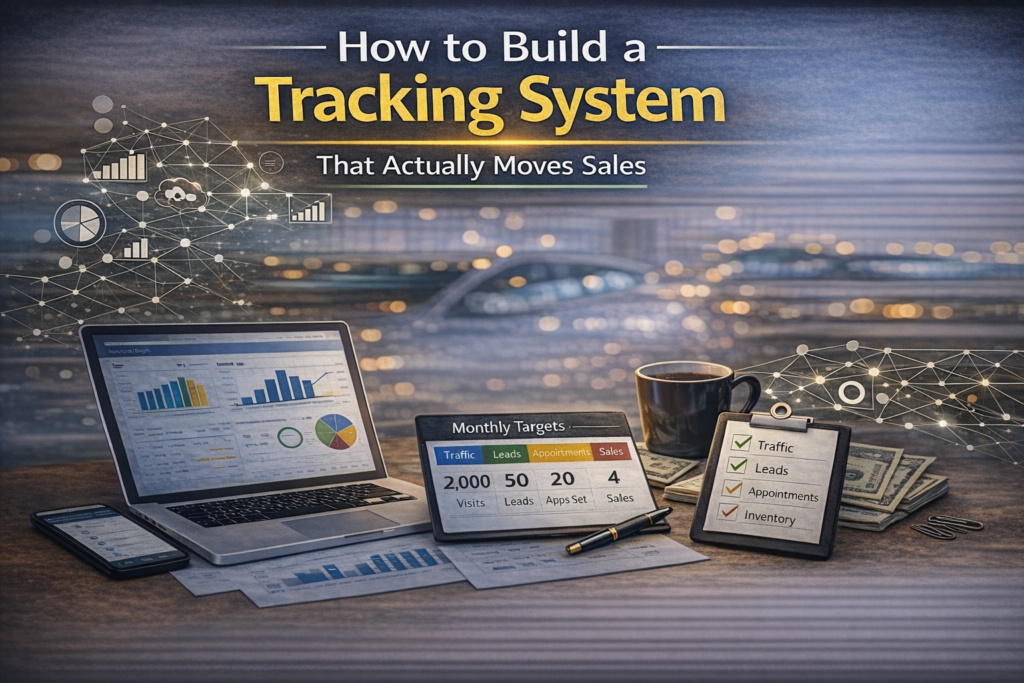
Why most dealerships are tracking the wrong things
The average store can tell you how many leads came in yesterday, but it often cannot tell you whether those leads were enough for pace, whether appointment ratios held, whether the front line is shrinking, or whether a vendor is actually doing the job it was hired to do.
That is the trap. A dealership ends up reviewing activity instead of managing a system. One manager is looking at website sessions. Another is looking at lead count. Another is worried about sold units. Used cars is worried about recon and aging. Marketing is defending CPC and CTR. Everyone has data, but nobody is working from one scoreboard.
The result is predictable. When sales soften, leadership reacts emotionally. Budgets get shifted, vendors get blamed, and stores chase another quick fix. But growth rarely breaks because of one number. It usually breaks because one stage of the system is leaking and nobody can prove where.
What a real dealership tracking system should answer
A proper dealership growth system should answer three questions every day. Where are we now? Where do we need to go? Which lever is actually holding the store back?
If your scorecard cannot answer those questions quickly, it is not a management tool. It is just reporting.
This is the shift dealers need to make. Stop asking for more leads in the abstract. Start asking whether traffic is on pace, whether traffic is converting, whether appointments are being set and shown, whether the store is closing opportunities, and whether inventory is ready enough to support next month instead of just surviving this month.
Start with a baseline before you set a goal
Too many dealerships start with a unit target and skip the baseline. That is backward. Before you demand 100 or 150 units this month, you need to know what your store has actually been producing and what the underlying ratios look like.
Benchmark website traffic, leads, traffic-to-lead rate, appointment set rate, show rate, show-to-sold rate, front-line-ready inventory, inventory replacement pace, lead response time, paid media efficiency, and overall sales efficiency. Those numbers tell you whether your growth problem lives in acquisition, conversion, execution, or inventory readiness.
Then break the baseline into monthly, weekly, and daily pace. Monthly targets are too far away to manage. Daily pace is where accountability becomes real. If you are behind on Day 5, you still have time to act. If you discover the gap on Day 25, you are running an autopsy, not a dealership.
Reverse-engineer the sales target
Once you know the store’s current ratios, the sales goal stops being motivational language and becomes math. If you know your traffic-to-lead rate, lead-to-set rate, set-to-show rate, and show-to-sold rate, you can build backward from the unit goal to the exact opportunity volume the store must create.
That matters because it changes how the conversation sounds inside the building. Instead of saying, “We need to sell more,” leadership can say, “Traffic is below pace,” “lead-to-set is slipping,” or “shows are healthy but close rate dropped.” That is real management language because it points to a controllable lever.
Dealers that reverse-engineer growth stop reacting to outcomes after the fact. They manage the chain that creates the outcome in the first place.
Build one master scorecard, not five disconnected reports
The best system is not the one with the most dashboards. It is the one that keeps the store aligned. One master scorecard should connect marketing, BDC, sales, used cars, and inventory into one operating view.
A strong structure usually includes four layers. First, a baseline tab with historical averages and core ratios. Second, a daily pace tab that compares live performance to required daily pace. Third, a weekly funnel tab that reveals where the chain weakened. Fourth, a vendor scorecard that grades partners by role, not by noise.
That structure gives leadership one source of truth. It also makes the weekly meeting far more productive because everyone walks in looking at the same business instead of defending a silo.
Grade vendors by role, not by raw lead count
This is one of the biggest mistakes in automotive retail. Stores frequently judge every vendor as if every vendor exists to create form fills. That is lazy evaluation and it leads to bad decisions.
Traffic drivers should be judged on visibility, sessions, engagement quality, click-through rate, and cost efficiency. Lead drivers should be judged on lead volume, cost per lead, lead quality, and downstream appointment ratios. Conversion drivers should be judged on response speed, friction reduction, and lift in lead-to-set or set-to-show performance. Inventory movement drivers should be judged on vehicle-level exposure, target inventory activity, time-to-sale improvement, and replacement support.
Once vendors are graded against the job they were hired to do, the conversation changes. A channel that produces strong traffic and strong inventory exposure may still be valuable even if lead share is soft, especially when the real breakdown sits on the website, in the BDC process, or in inventory readiness. Dealers often cut the channel when they should have fixed the conversion point.
Treat inventory like part of the funnel
Inventory is not a separate conversation from marketing and sales. It is part of the conversion system. If vehicles are not front-line ready, not merchandised correctly, not priced with clarity, or not actually available, the store wastes traffic before the sales process even begins.
That is why a true dealer growth tracker has to include front-line-ready new units, front-line-ready used units, weekly front-line change, units sold, units replaced, replacement rate, and aged inventory concentration. A store that sells faster than it replenishes can create an illusion of momentum while quietly weakening next month.
A lot of dealerships think they have a sales problem when the deeper issue is inventory replacement pace. They moved metal this month, but they pulled forward from next month to do it. That is not durable growth. It is drift.
Run the business on cadence: daily, weekly, monthly
Daily is for pace. Weekly is for diagnosis. Monthly is for structural decisions. That cadence is simple, but it is powerful because it stops the store from doing everything at the wrong time.
Daily management should answer whether traffic, leads, appointments, sold units, and front-line inventory are on pace. Weekly review should answer which ratio weakened, which vendor underperformed its role, whether response time slipped, and whether inventory is shrinking in the wrong places. Monthly review should answer which partners earned more trust, which ones need to be fixed or cut, and which stage of the funnel became the dominant bottleneck.
That is how a dealership stops operating like a weather pattern and starts operating like a business.
Know which lever to pull first
The entire purpose of the scorecard is to tell you what matters most right now. If traffic is weak, fix media mix, search visibility, landing pages, and inventory exposure. If traffic is healthy but leads are weak, fix SRPs, VDPs, CTAs, merchandising, pricing clarity, and mobile experience. If leads are healthy but appointments are weak, fix response speed, follow-up quality, scripting, and accountability. If appointments are healthy but shows are weak, fix confirmations, reminders, value building, and appointment quality. If shows are healthy but sold is weak, fix in-store execution, desk process, selection, pricing strategy, and trade handling.
And if sold units look fine but next month looks soft, fix front-line inventory and replacement pace immediately. Not every slow month is a vendor problem. Not every lead problem is a marketing problem. Not every sales problem is a closing problem. The tracker exists to isolate the real lever.
The bottom line
Dealership growth does not come from demanding more leads. It comes from building a scorecard that ties traffic, conversion, appointments, sold units, inventory readiness, and vendor accountability into one operating system.
Set the benchmark. Break the target down to the day. Grade vendors by role. Track the funnel. Track front-line inventory. Track replacement pace. Find the bottleneck. Pull the right lever. Then repeat.
If a dealership does that consistently, growth stops feeling random. It becomes measurable, manageable, and repeatable.